
What if the cheapest transaction is the one most likely to expose you to a loss? In decentralized finance, users often treat gas optimization as a narrow budgeting exercise: wait for a lower fee, choose a cheaper network, or reduce the number of transactions. Those choices can matter, but they also change timing, execution risk, and the amount of information a user must interpret before signing. A transaction that saves a few dollars may create a larger security problem if it relies on a stale quote, an unfamiliar contract, or a rushed approval.
The more useful question is not “How do I pay the least gas?” It is “What combination of cost, execution certainty, and signing safety is appropriate for this transaction?” That framing is especially important for US-based DeFi users, who may move between Ethereum, layer-2 networks, and other EVM-compatible chains with different fee markets and application risks. Gas optimization and wallet security are related, but neither guarantees the other.
Three Ways to Optimize Gas, and What Each One Sacrifices
Consider three broad approaches. The first is immediate execution: submit the transaction with a fee high enough to make inclusion reasonably likely. The second is fee-market timing: wait for congestion to ease, then submit with a lower fee. The third is structural optimization: use batching, permit-style approvals where appropriate, an aggregator, or a lower-cost network to reduce the total number or price of transactions. None is universally superior. Each shifts risk rather than eliminating it.
Immediate execution: higher cost, lower waiting exposure
Paying more for priority can be rational when the transaction is time-sensitive. A collateral position near liquidation, a rapidly changing swap, or an expiring opportunity may lose more value through delay than through a higher network fee. The important distinction is between a transaction fee and a transaction outcome. A higher priority fee may improve the chance of prompt inclusion, but it does not make a bad trade good, a malicious contract safe, or a slippage setting sensible.
There is also a subtle security benefit to reducing delay: fewer minutes are available for market conditions, quotes, or application state to change. Yet urgency can impair review. A user who sees a rising gas estimate may click through a warning simply to avoid missing a trade. That is why “fast” should never be confused with “safe.” In practice, the appropriate question is whether the financial consequence of waiting is demonstrably greater than the added cost, not whether the network feels busy.
Waiting for a cheaper fee: economic efficiency with timing risk
Waiting can be sensible for routine actions such as moving funds between one’s own accounts or claiming a reward with no meaningful deadline. On Ethereum-like networks, the fee environment changes with demand. Users may avoid unnecessary peak pricing by postponing a transaction, but the saving is conditional: congestion can persist, the application’s state can change, and a quote or intended trade may become stale.
Replacement transactions create another boundary condition. If a transaction remains pending and the user later attempts to speed it up, the replacement must generally use the same nonce and meet the network’s replacement rules. Poorly understood nonce management can produce confusion: the user may think a transaction failed when it is merely pending, or may submit a second action that depends on the first. A wallet that presents pending transactions clearly is therefore part of the safety process, although no interface can remove the underlying network mechanics.
Batching and alternate networks: lower unit cost, broader trust assumptions
Structural optimization aims to reduce the number of on-chain actions. Approving a token once and then trading several times may cost less than repeating approvals, and batching can reduce repeated overhead where the application and wallet support it. Layer-2 networks can also offer lower fees because transactions are processed under a different architecture and later anchored, in some form, to a base chain.
The trade-off is that the user must evaluate more than gas. A bridge introduces an additional contract and operational dependency. A new network may have less mature applications, thinner liquidity, different withdrawal timing, or a smaller set of independently scrutinized protocols. A transaction can therefore be cheaper while the surrounding system is harder to assess. The general principle is simple: every reduction in transaction cost should be checked against the additional assumptions needed to obtain it.
Why Gas Settings Cannot Protect a Bad Transaction
Many users intuitively treat gas as a control knob for transaction safety. It is not. Gas determines how much computational work a transaction may consume and, together with the fee parameters, how it competes for inclusion. It does not validate the recipient, inspect the economic logic of a protocol, or guarantee that a token approval is limited to the amount the user intended.
On networks using a base fee and a priority fee, the base component reflects network conditions while the priority component is an incentive for validators or block producers to include the transaction. The exact interface varies by network and wallet. A wallet may estimate a suitable fee, but estimates are probabilistic. They can be affected by sudden demand, unusual contract execution, or a transaction that consumes more computational resources than expected. A user should understand that a fee estimate is a forecast of inclusion cost, not a certification of contract behavior.
The more important security checkpoint is the transaction’s meaning. Is the user sending assets to the intended address? Is the contract the expected protocol? Is the function call consistent with the visible action? Does an approval grant spending authority to a known contract, and is the allowance larger or longer-lived than necessary? These questions remain relevant whether gas costs two dollars or two hundred dollars.
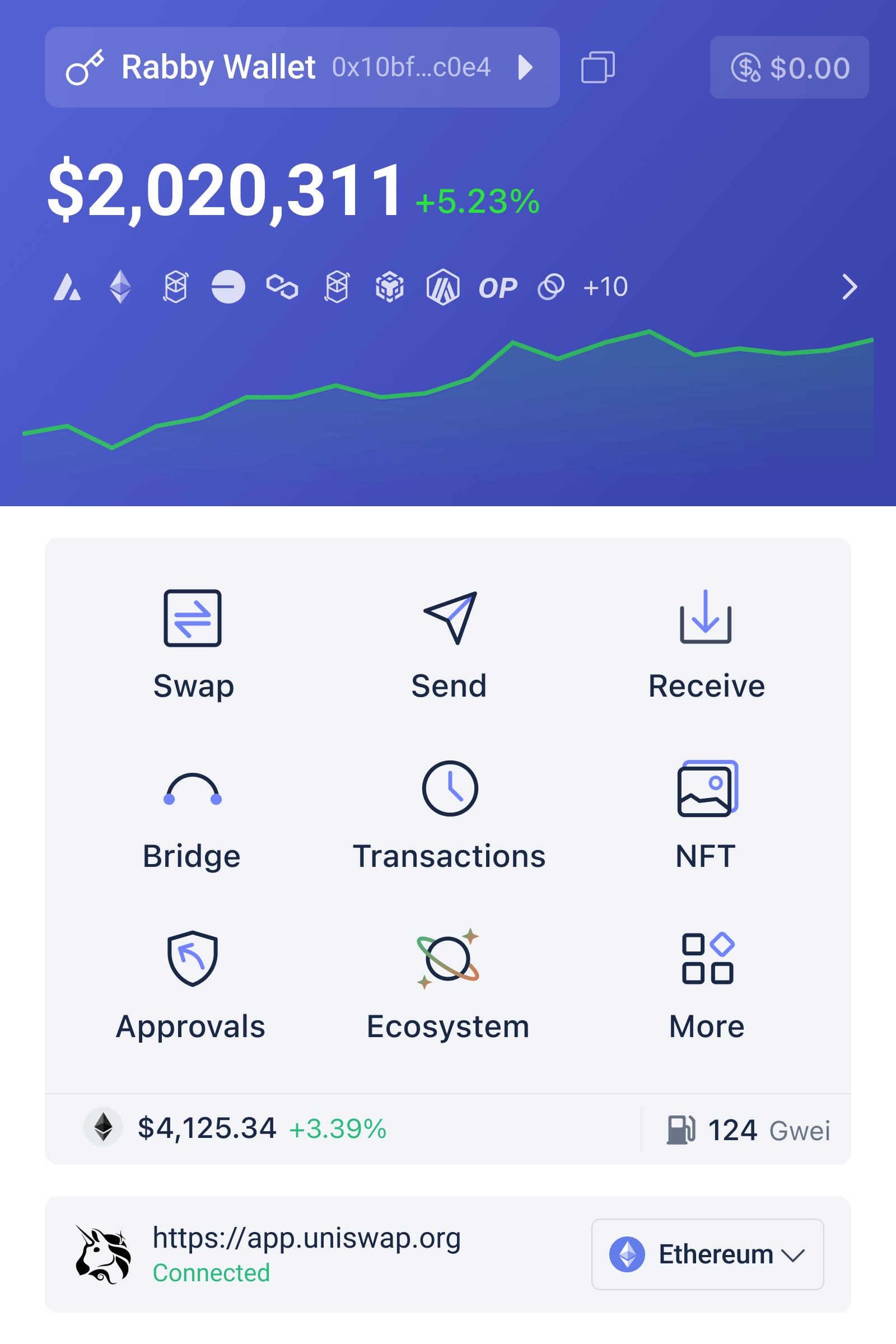
This is where transaction simulation and clear signing information can be useful. A wallet interface that shows expected asset changes, warnings, contract details, and network context can help users compare what they intend to do with what the transaction appears to do. Such tools are aids to judgment, not substitutes for it. Simulations can be incomplete, a contract can behave differently under changed state, and a warning system can miss an unfamiliar attack pattern. Users installing a browser wallet should obtain it through a verified source; for readers evaluating the rabby extension, the installation step itself deserves the same caution as a DeFi transaction.
Wallet Security: The Often-Ignored Cost of Convenience
A wallet is not merely a key container. In everyday DeFi use, it is also a decision interface. It displays network selection, account identity, fee estimates, contract requests, token changes, and approval prompts. If those signals are poorly understood, gas optimization can amplify risk by encouraging rapid, repeated actions.
One common misconception is that a hardware wallet solves the entire security problem. Hardware signing can protect private keys from some forms of malware, but it does not make a user immune to phishing, malicious approvals, wrong-network transactions, or deceptive contract calls. The device may confirm a transaction that the user has misunderstood. Hardware protection is valuable, but it protects a different layer of the system than transaction interpretation.
Another misconception is that a low gas estimate signals a low-risk protocol. It does not. Gas depends on computational complexity and network demand, not on the honesty of the application. A simple token transfer to a scam address can be cheap. A complex, legitimate operation can be expensive. Treating fee size as a proxy for trustworthiness reverses the relevant logic.
Browser-extension wallets introduce practical attack surfaces that deserve explicit attention. Fake download pages, malicious extensions, clipboard replacement, exposed seed phrases, and misleading pop-ups can all redirect a user before the blockchain transaction is even considered. A disciplined setup includes checking the source, reviewing permissions, protecting the recovery phrase offline, separating experimental activity from long-term holdings, and avoiding approval prompts that cannot be explained in plain language.
A Practical Framework for Safer Gas Decisions
A reusable decision framework can be built around four questions. First, how time-sensitive is the transaction? If delay could trigger liquidation or materially alter execution, paying for prompt inclusion may be justified. If the action is routine, waiting may be reasonable. Second, what is the consequence of failure or partial completion? A failed transaction still consumes gas, while a successful but unfavorable swap can create a much larger loss.
Third, how many trust assumptions are being added? Moving to another network, using a bridge, granting an approval, or relying on an aggregator may reduce fees but expand the set of contracts and services that must be trusted. Fourth, can the intended outcome be independently understood before signing? If the answer is no, a lower fee is not the most urgent problem.
For a routine transaction, a cautious sequence is more useful than a single “best” gas setting. Confirm the account and network. Check the recipient or protocol address through a trusted path. Review the expected asset changes. Inspect approvals separately from swaps or deposits. Compare the fee with the value and urgency of the action. Then decide whether waiting, paying for priority, or using another execution route is justified.
Users should also distinguish between reducing gas per action and reducing unnecessary actions. The latter is often safer. Repeating failed submissions, making speculative approvals, and moving funds across networks merely to chase a small fee difference can produce more total exposure than a single well-reviewed transaction. Optimization is strongest when it removes redundant behavior, not when it encourages increasingly complex routes.
What to Watch as DeFi Interfaces Mature
If wallet interfaces become better at simulation, intent display, and network-specific warnings, users may be able to make more informed trade-offs without studying every low-level parameter. That would be a meaningful improvement, but it would not end the security problem. Protocol upgrades, new chains, changing token permissions, and adversarial contract design will continue to create cases that automated systems cannot fully interpret.
The likely direction is toward more explicit separation between three decisions: whether a user trusts the application, what outcome the user wants, and how much the user is willing to pay for inclusion. Interfaces that combine these into one hurried approval can obscure risk. Interfaces that expose the distinctions may help users spend more intelligently and sign less blindly. The outcome will depend on how accurately the tools model changing state and how willing users are to stop when the information is ambiguous.
For now, the durable lesson is narrower and more practical. Optimize gas after establishing that the transaction is necessary, the application is understood, and the wallet environment is trustworthy. A fee-saving tactic is successful only when the saving survives contact with execution risk. In DeFi, the cheapest path is not the one with the smallest number on the confirmation screen; it is the path that reaches the intended result without adding assumptions the user has not examined.
Frequently Asked Questions
Does paying a higher gas fee make a DeFi transaction safer?
No. A higher fee can improve the likelihood or speed of inclusion, which may matter for time-sensitive actions. It does not verify a contract, prevent phishing, limit an approval, or correct an unfavorable swap. Safety depends primarily on understanding the transaction and protecting the wallet environment.
Is using a layer-2 network always the best way to reduce gas costs?
No. Layer-2 networks may reduce transaction costs, but users must consider bridge risk, application availability, liquidity, withdrawal mechanics, and the maturity of the contracts involved. A lower fee is attractive only when the network and protocol are appropriate for the intended transaction.
What is the safest way to optimize gas for a routine transaction?
First verify the account, network, recipient, contract, and expected asset changes. Then compare the transaction’s urgency with current fee conditions. If delay has little consequence, waiting may reduce cost. Avoid unnecessary approvals, repeated retries, and complicated cross-network routes undertaken solely to save a small amount.